Why Humans Resist Change (And How Great Companies Overcome It)
Every organization eventually reaches a point where change is no longer optional. Markets evolve, technologies advance, customer expectations shift, and competitors discover more efficient ways of operating. Yet despite investing heavily in new strategies and technologies, many organizations find that meaningful change is far more difficult than anticipated.
The challenge rarely lies in designing a better strategy. More often, it lies in helping people embrace it. New software remains underutilized, teams quietly return to familiar workflows, and ambitious transformation projects lose momentum after an enthusiastic launch. From a leadership perspective, this can look like stubbornness. In reality, the resistance usually has deeper psychological roots.
A common misconception is that people naturally dislike change. Human history says otherwise: we adapt constantly, learning new skills, changing careers, navigating major life transitions. Change itself is not the problem. What people struggle with is the uncertainty that accompanies it, and the possibility that the future may leave them worse off than the present.
Change Isn't the Threat, Uncertainty Is
Consider an employee arriving at work to discover the company is replacing its project management system. Leadership presents the announcement with optimism: increased efficiency, better collaboration, long-term benefits. To employees, it raises a different set of questions: Will I learn this fast enough? Will my productivity visibly drop while everyone's watching? Will my experience still matter, or will I feel like a beginner again?
These concerns aren't about the software. They're about uncertainty. The brain has evolved to treat uncertainty as risk, prompting a pull toward familiarity, even in a modern workplace far removed from the environments that shaped that instinct. Before people evaluate the benefits of a change, they evaluate the risks it might introduce.
The Psychology Behind Resistance
The strongest force here is loss aversion: the tendency to feel the pain of a loss more intensely than the pleasure of an equivalent gain. Even when a new initiative offers real advantages, employees often focus first on what they might lose: confidence, mastery, predictability, autonomy, professional identity. Someone who spent years becoming efficient with an old process may experience a new system as resetting that expertise to zero, not just new software, but a temporary loss of competence.
The second force is status quo bias: preferring existing conditions simply because they're familiar, even when the current process is objectively worse. Resistance often has less to do with employees believing the old system is better, and more to do with it being known. In the short term, the discomfort of uncertainty can outweigh the promise of future improvement.
Why Logic Alone Rarely Changes Minds
Many change initiatives lean heavily on facts: market research, financial projections, compelling business cases. These arguments may be entirely valid, yet they often miss the emotional experience of the people asked to implement the change.
Emotions shape whether people are open to new ideas long before they start evaluating evidence. When employees feel uncertain or threatened, more data rarely dissolves that feeling, it explains the change without building confidence in it. This is why effective change management goes beyond communication and focuses on psychological safety: an environment where people can ask questions, make mistakes while learning, and voice concerns without fear of judgment. Once that safety exists, logical arguments finally land, because people are emotionally ready to hear them.
How Great Companies Approach Change Differently
Organizations that navigate transformation well treat change as a human challenge, not a technological one. Instead of asking "how do we persuade employees to accept this," they ask "how do we reduce uncertainty throughout the transition." That shift changes the entire strategy.
In practice, this looks like:
- Gradual rollout instead of sweeping overnight changes, giving people time to build familiarity
- Consistent communication before and throughout implementation, not just at launch
- Employee involvement in shaping solutions and giving feedback — participation creates ownership, and people support what they helped build
- Early wins that let confidence grow from real experience rather than promises
- Normalizing mistakes as part of adaptation rather than evidence of failure
Trust, in these organizations, is built through actions rather than announcements. Each successful rollout reinforces that leadership listens and adapts, and over time, employees start viewing change as opportunity rather than threat.
The Real Role of Leadership
One of the biggest mistakes leaders make is interpreting resistance as opposition. Often it's simply a signal of unanswered questions or unresolved concerns, a desire to preserve competence and stability, not an unwillingness to contribute.
Pressure can produce compliance, but rarely genuine commitment. Curiosity uncovers the real barriers. By understanding what people fear losing, leaders can design transitions that protect those needs while still moving the organization forward.
Final Thoughts
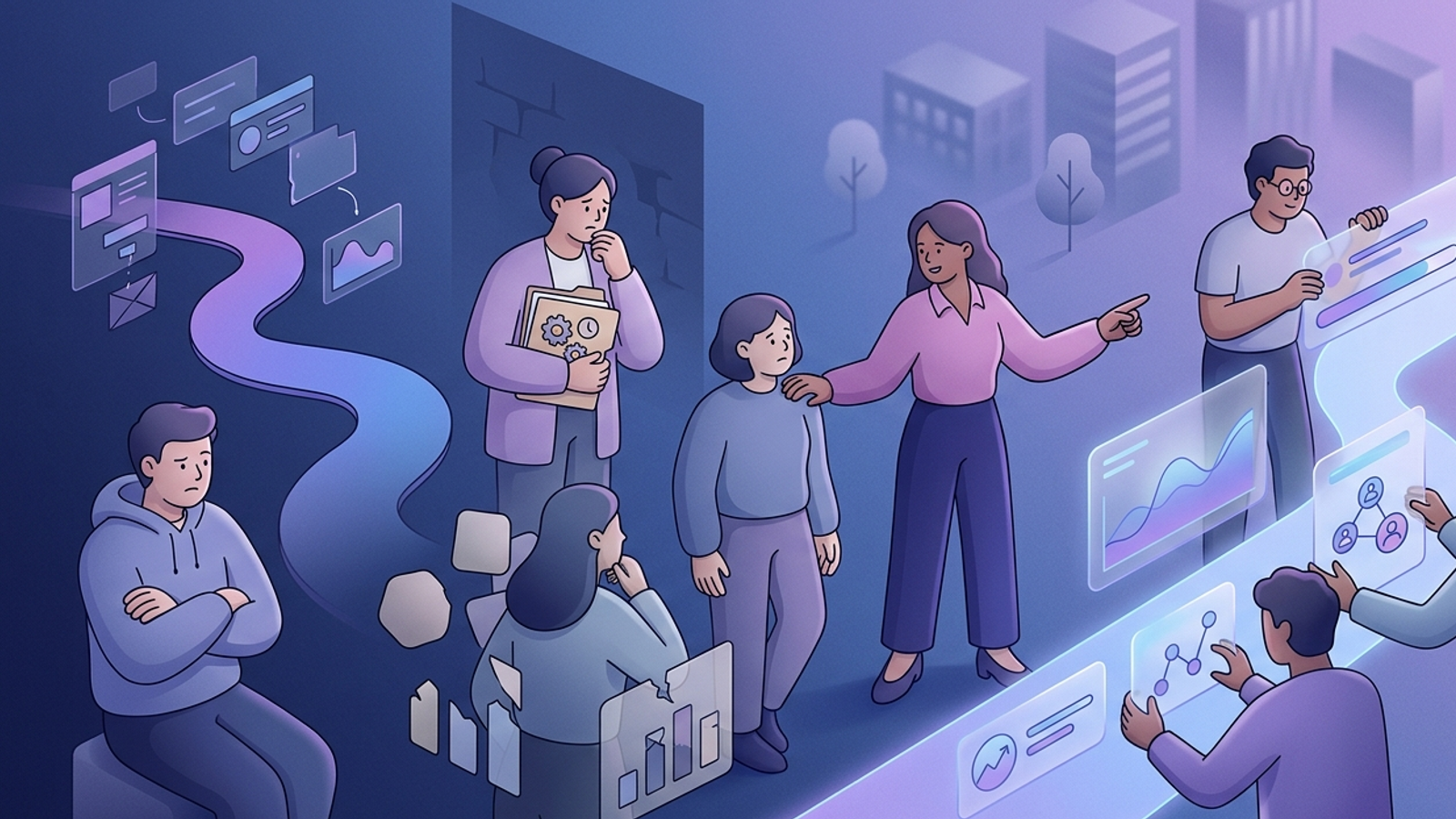
Every organizational transformation asks people to leave something familiar in pursuit of something uncertain. Whether that journey succeeds depends less on the technology being introduced and more on the environment surrounding its adoption.
The organizations that embrace change most effectively aren't the ones with the newest tools, they're the ones that understand human psychology. By reducing uncertainty, fostering trust, and involving employees throughout the process, they turn resistance into participation and hesitation into confidence.
Change isn't won through better technology alone. It's won by designing systems that work with human nature instead of against it.
Continue Exploring the Human Side of Business
At Hexifyer, we believe that successful organizations are built at the intersection of technology, psychology, and strategy. We explore how people think, collaborate, and make decisions because understanding human behavior is often the key to building businesses that grow, innovate, and endure.
Continue exploring Hexifyer's knowledge library to discover practical frameworks for building businesses that aren't just busier but smarter, more intentional, and designed for sustainable growth.