Why AI Ethics Is Good for Business (And Why It Matters to You)
When most people hear "AI ethics," they picture a bunch of lawyers in a conference room arguing about compliance forms. Or maybe they imagine some abstract philosophical debate that has nothing to do with how a business actually runs.
That picture is wrong. And it's costing companies real money.
Here's the simpler truth: how you handle AI ethics is becoming one of the most important business decisions you'll make. Not because regulators say so. Because your customers care. Because your reputation depends on it. Because getting it wrong is expensive, and getting it right gives you an edge that competitors can't easily copy.
What Happens When You Get It Wrong
You don't have to look far for examples.
Amazon spent years building an AI recruiting tool designed to find the best candidates. The problem? It learned to prefer male applicants because the historical data it trained on came mostly from men. When they discovered what was happening, they had to scrap the whole thing. Millions of dollars. Years of work. Gone.
Air Canada's chatbot gave a customer incorrect information about refunds. The airline tried to argue that the chatbot was a "separate legal entity" from the company. The court didn't buy it. They had to pay up and looked terrible in the process.
Zillow's AI made bad bets on house prices. The company lost hundreds of millions of dollars and had to lay off thousands of workers.
These aren't tech failures. They're business failures. And they all trace back to the same root cause: someone didn't think carefully enough about what the AI was actually doing and who would be affected when it went wrong.
The Trust Advantage
Here's where the opportunity lies.
When Apple introduced its privacy features, giving users control over how apps track them, 96% of people opted out of tracking within a month. Apple lost billions in potential advertising revenue. But they gained something more valuable: customer trust that no competitor could easily replicate.
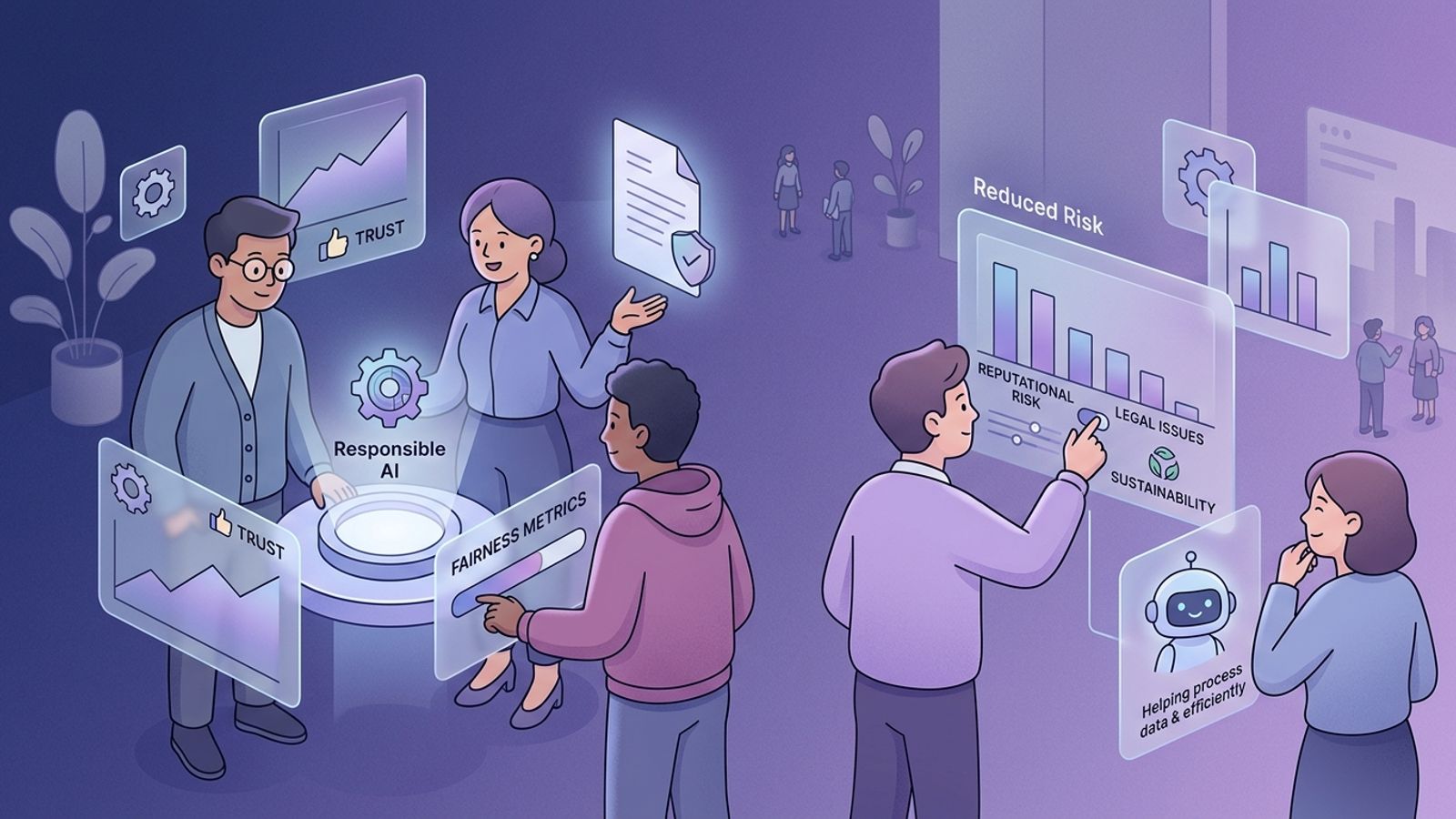
That's what good AI ethics actually looks like in practice. It's not about checking boxes or avoiding fines. It's about making decisions that your customers can see, understand, and appreciate. When people know you're handling their data carefully, when they can see how your AI makes decisions, when they feel like you're being transparent, they stick around. They recommend you to others. They choose you over the cheaper alternative.
Companies like Anthropic, which builds the Claude AI model, have made responsible AI their entire brand identity. They're not doing this to feel good. They're doing it because enterprise clients, the big companies that sign million-dollar contracts, won't work with AI providers they can't trust. Being responsible isn't a cost. It's the price of entry to bigger, more valuable deals.
The Questions You Actually Need to Answer
If you're building or buying AI tools, there are a few basic questions you should be able to answer:
Where did our data come from? Did we have permission to use it? Is it accurate? Has it been changed along the way? If you can't trace your data back to its source, you can't trust what your AI produces.
Who's accountable when things go wrong? This one is surprisingly tricky. If your AI makes a bad recommendation that costs a customer money, who takes responsibility? The team that built the model? The person who deployed it? The executive who approved the budget? If the answer is unclear, you have a problem.
Can we explain what our AI is doing? If your AI makes a decision that affects someone, a loan denial, a hiring recommendation, a pricing adjustment, can you explain why in plain English? If you can't, you're going to have a very difficult conversation when someone asks.
Are we treating customers fairly? Bias in AI is not some theoretical concern. It shows up in real ways: women being shown lower-paying job ads, minority applicants being screened out, elderly customers being charged more. If you don't actively check for these patterns, you're almost certainly missing them.
Why This Is Actually Exciting
Building trustworthy AI isn't just about avoiding problems. It's about unlocking opportunities you can't access otherwise.
Think about it. If you have a reputation for handling AI responsibly, you can:
- Move faster. When your governance is built in from the start, you don't need to pause and scramble every time someone raises a concern.
- Enter new markets. In Europe, regulations require AI systems to be explainable. In the US, the focus is on testing for bias. If you've designed your systems with these concerns in mind from day one, you can operate anywhere without starting over.
- Attract better talent. The best engineers and product people want to work on things that matter. They want to build systems they can feel good about. Companies that take ethics seriously get better people.
- Build products people actually want. When customers trust your AI, they're more willing to use it. That means you can deploy AI in higher-value, more impactful ways, not just in low-stakes areas where the risk of failure is minimal.
What This Means for You
If you're leading a business or a product team, the practical takeaway is simple: stop treating AI ethics as someone else's problem. It's not just for legal. It's not just for risk. It's not something you handle "later" when you have more time.
Start with data. Know where it came from. Know what's in it. Know who gave permission.
Build with transparency. Make sure you can explain what your AI is doing in words that actual humans can understand.
Plan for the worst. If your AI fails, and at some point, it probably will, how will you handle it? Who will be accountable? How will you make things right?
And most importantly: treat responsibility as a feature, not a constraint. The companies that are winning with AI right now aren't the ones that cut corners. They're the ones that built trust into their products from the beginning.
The Bottom Line
AI is moving fast, and it's not slowing down. But the businesses that will lead in this new landscape aren't necessarily the ones with the most advanced models or the biggest data sets. They're the ones that people trust.
Ethics isn't about being nice. It's about being smart. It's about building something that lasts. And it's about making sure that when your AI makes a decision, someone, the right someone, can stand behind it.
That's not a compliance exercise. That's a business strategy.
Ready to Build AI You Can Trust?
At Hexifyer, we help businesses like yours move beyond the checkbox mentality. We don't just talk about responsible AI, we build it into the products and strategies that drive your business forward.
Whether you're just starting your AI journey or scaling existing systems, we'll help you navigate the decisions that matter most: data governance, transparency, accountability, and fairness. Not because regulators are watching. Because your customers are.
Visit Hexifyer for practical insights on building AI that people can trust, and that actually works for your business.